INTRODUCTION:
The annual memorial of Christ’s death has arrived once again, and I would like to present this revised narration of the Passover week, following the first one I presented in 2009. Since my initial presentation, I have found it necessary to make corrections because I now have a greater understanding of Scripture. Most importantly, in this updated revised version, I have corrected the false narrative that Jesus arose from the tomb early Sunday morning. I now see how translators have manipulated Scripture by translating the Greek word, Sabbaton, as “week.” They have done so to maintain the false traditional preaching rather than to understand that Jesus arose early in the morning on one of the Sabbaths (there were three) that occurred during the feast days of unleavened bread.
In narrating the Easter story, I have sought to harmonize the details from the four Gospels, acknowledging that each account has gaps; however, there are no contradictions. I base every detail on Scripture with no attempts to add or take away. By keeping to God’s Word, I believe a powerful Easter story has emerged.
NISAN 14
3 pm (ninth hour)
Nisan 14 was the day the lambs were slaughtered for the Passover supper. Secular records reveal the preferred time to slaughter was at the ninth hour. The killing of the lambs foreshadowed Jesus, as the sacrificial lamb of God.
Before the Passover supper, Jesus was in Bethany in the house of Simon the leper when a woman (unnamed) came with an alabaster box of a very precious ointment. After breaking the box, the woman poured the precious ointment upon Jesus’ head. His disciples expressed indignation at what she had done. They murmured against her and asked, “Why was this waste of the ointment made?” Their thoughts were that the ointment might have been sold and the money given to the poor. But Jesus upbraided them. “Let her alone,” He said, “For you have the poor with you always, and whenssoever you will, you may do them good, but me you have not always.” (Matthew 26:6-13; Mark 14:3-9)
The disciples failed to understand the significance of what this woman had done. There were two separate earlier occasions when precious ointment was only poured upon the feet of Jesus. There was the time when Jesus was in the house of a Pharisee (Luke 7:36-50). Another time, Jesus was at the home of Lazarus (John 12:1-8). In these earlier accounts, it’s told how each time the woman wiped his feet with her hair, no ointment was poured on His head. Those times did not have the same significance as what happened this particular afternoon. We cannot know for certain if it’s the same woman, one called Mary, at this time, who anointed His head. However, this is the one important occasion Jesus said, “Wheresoever this gospel shall be preached throughout the whole world, this also that she had done shall be spoken of for a memorial of her.” (Matthew 26:13; Mark 14:9)
What had she done?
As lambs were being slaughtered that afternoon in Jerusalem three days before his crucifixion, Jesus said:
“For in that she hath poured this ointment on my body, she did [it] for my burial.” (Matthew 26:12)
“She hath done what she could: she is come aforehand to anoint my body to the burying.” (Mark 14:8)
In order for Jesus to suffer and be put to death, he had to take on our sins. Again, at this very moment, the Jews had begun to slaughter the Passover lambs in preparation for the evening feast. By anointing Jesus’ head, this woman was giving the sign that Jesus had entered the “heart of the earth” (Matthew 12:40). With our finite minds, we are unable to comprehend how Jesus was spiritually infected with our sins in order to die. And so the 72-hour (three days and three nights) countdown that Jesus would be in the “heart of the earth” (Matthew 12:40) had begun this hour.
And the first day of unleavened bread, when they killed the passover, his disciples said unto him, Where wilt thou that we go and prepare that thou mayest eat the passover? (Mark 14:12)
Even ( sixth hour)
On the evening of Nisan 14, Jesus sat down and ate the last supper with his disciples. (Matthew 26:20-21; Mark 14:17; Luke 22:14) It was called the “Lord’s Passover” (Leviticus 23:5). During the supper Jesus said unto them, “With desire I have desired to eat this passover with you before I suffer: For I say unto you, I will not any more eat thereof, until it be fulfilled in the kingdom of God. And he took the cup, and gave thanks, and said, “Take this, and divide among yourselves: For I say unto you, I will not drink of the fruit of the vine, until the kingdom of God shall come. And he took bread, and gave thanks, and brake it, and gave unto them, saying, This is my body which is given for you: this do in remembrance of me”.
“And he took the cup, and gave thanks, and gave it to them, saying, Drink ye all of it; For this is my blood of the new testament, which is shed for many for the remission of sins.” (Matthew 26:26-30; Mark 14: 22-26; Luke 22:15-20).
After this Passover supper, He and His disciples went to a place called Gethsemane. Jesus came here to pray, knowing it was approaching time for Him to die. (Matthew 26:36) Judas Iscariot had betrayed him and was leading a band of Jews to where they could capture Jesus that night.
As Jesus prayed, we can know that he was in the “heart of the earth.” His soul was in agony, being in a spiritual state, having taken the cup. Jonah’s prayer, while in the belly of the whale, was a foreshadowing of the agony Jesus would suffer for our sins in the “heart of the earth.” He prayed, “Abba Father, all things are possible unto thee; take away this cup from me; nevertheless not what I will, but what thou wilt.” (Matthew 26:39; Mark 14:36)
“And being in agony, he prayed more earnestly: and his sweat was as it were great drops of blood falling down to the ground.” (Luke 22:44)
After a while, the Jews came with lanterns, torches, and weapons and laid hold of Him. They bound and took Jesus to the high priest, where all the Jewish leaders were assembled. After hearing false witnesses against Jesus, these Jewish leaders agreed that Jesus was worthy of death.
During this dreadful night, Peter denied the Lord three times before the cock crowed twice (Mark 14:30)
Although the Jews decided Jesus must die, they lacked the authority under Roman rule to put someone to death (John 18:31). With nothing more that could be done that night, they closed the council until morning.
Nisan 15
And on the fifteenth day of the same month is the feast of unleavened bread unto the Lord: seven days ye must eat unleavened bread. (Levitcus 23:6)
Morning:
The Jews Council Appears Before Pilate
As soon as daybreak, the elders of the people, the chief priests, and the scribes came together and led Jesus into their council again. There was given more time for questioning until they heard enough. (Luke 22:66-71) It was still early morning when they delivered Jesus, still in bonds, to Pontius Pilate, the Roman Governor. (Mark 15:1) There, the chief priests, elders, scribes, and the whole council stood before Pilate demanding that Jesus be put to death. Pilate needed to know what for?
In the meantime, Judas went away and hanged himself, knowing he had betrayed innocent blood. ( Matthew 27:5)
This was an important holy day for the Jews. It being the first day of unleavened bread, these religious leaders having brought Jesus to Pilate stopped short of going into the hall of judgment, “lest they should be defiled; but that they might eat the passover,” (John 18:28). Although the Jews were persistent in their argument and claims against Jesus, Pilate was quite reluctant to sentence Jesus to death. Each time Pilate entered the hall of judgment to question Jesus, he came out to declare he found no fault in Jesus, but the Jews were adamant that Jesus be put to death.
And when Pilate heard that Jesus was a Galilean, he sought to clear himself of the matter by sending Jesus to Herod, since Galilee was under Herod’s jurisdiction. (Luke 23:6,7) Furthermore, it was a perfect convenience that Herod was visiting Jerusalem at that time. This was the same Herod, the tetrarch, who had earlier beheaded John the Baptist (Luke 9:9)
Jesus stands before Herod
Herod was very desirous of seeing Jesus, having heard many things about him (Luke 23:8; Matthew 14:1). The chief priests and scribes had come to accuse Jesus vehemently before Herod, just as they had before Pilate. But Jesus stood silent, even refusing to answer questions posed to him by Herod. It did not go well for the priests and scribes before Herod, as nothing they said convinced Herod that Jesus was worthy of death. Herod saw Jesus as no threat. And so with his men of war, Herod mocked Jesus and arrayed Him in a gorgeous robe and delivered Him back to Pilate. (Luke 23:1-15)
Pilate was afraid
What was Pilate to do now? The Jews had come back again to force a death sentence against Jesus, a man whom Pilate found no fault. (John 19:4) Pilate remained desperate to release Jesus because he was afraid. More so afraid when the Jews told him that it was by their law that Jesus should die because He made Himself the Son of God. (John 19:8). Also, Pilate’s wife had told him how she had suffered many things in a dream, and that he should have nothing to do with that just man (Matthew 27:19)
In an effort to satisfy the Jews, he had Jesus scourged and beaten by his soldiers and then presented Jesus to them, wearing a crown of thorns and a purple robe. “Behold the man! “ he said (John 19:5). But that was not enough.
Noon
Then about the sixth hour (noon), when it was still the preparation for the evening feast, Pilate declared, Behold your King! (John 19:14). However, the blood thirsty Jews would have none of that. It was not enough to beat him, humiliate him, and declare him a worthless king. Jesus must die!
TUESDAY EVENING (START OF SABBATH)
The choice between Jesus and Barabbas
Pilate made his last attempt to have Jesus released, as it was the custom that a prisoner (whomsoever the Jews desired) should be released at the Passover feast (Mark 15:6; John 18:39). They could either choose to free Jesus or Barabbas, a notorious thief and murderer! It was a last-ditch effort by Pilate to try to convince the Jews that Jesus should be released. However, the Jews chose to free Barabbas! There was no convincing the people to change their minds. In fact, it was the chief priests who moved the people to shout to crucify Jesus. Crucify! Crucify! (Mark 15:11) A tumult was made, and so Pilate had no choice but to give them what they wanted. In doing so, he washed his hands before the multitude, saying, “I am innocent of the blood of this just person: see ye [to it].” (Matthew 27:24)
NISAN 16
WEDNESDAY EVENING (SABBATH ENDED)
If you accept traditional church doctrine, you will continue to believe that Christ was led away directly to the cross after the sentence was given to be crucified. However, this belief leaves out key facts. The feast occurred at even (the start of the second feast day), at the going down of the sun (Deuteronomy 16:6). There are 12 hours in a day (John 11:9). Even is the twelfth hour. According to Mark’s gospel, Jesus was crucified in the morning at the third hour. (Mark 15:25)
Jesus was not crucified on Nisan 16 because it was still the Sabbath that lasted until the evening of Nisan 16.
NISAN 17
The place of the crucifixion was Calvary (Luke 23:33). In Hebrew, it was called Golgotha (John 19:17). Crucial hours were recorded on this day, which let us know it was a Thursday:
9 AM: Jesus was crucified the third hour (Mark 15:25)
Noon: About the sixth hour, Jesus told the thief on the cross that this day he would be with him in Paradise. (Luke 23:43) Note: This was a different day at “about the sixth hour” than when Pilate said, “Behold your King!
12 PM -3 PM: Then, from the sixth hour until the ninth hour (noon to 3 pm), there was darkness over all the land. “And the sun was darkened, and the veil of the temple was rent in the midst.” (Matthew 27:45; Luke 23:44)
3 PM: At the ninth hour, Jesus cried, “My God, my God, why hast thou forsaken me?” (Mark 15:34). When Jesus had received the vinegar, He said, “It is finished.”
Jesus Resurrection from the “Heart of the Earth”
Exactly 72 hours (three days and three nights) after the woman anointed Jesus’ head with precious ointment, He bowed His head and gave up the Ghost. (John 19:30). This resurrection occurred as His soul left the “heart of the earth” while his body remained on the cross. The body would be raised on the third day, as now His soul went into Paradise, just as He told the thief on the cross, “To day shalt thou be with me in paradise.” (Luke 23:43)
Jesus, when he had cried again with a loud voice, yielded up the Ghost. “And behold, the veil of the temple was rent in twain from the top of to the bottom; and the earth did quake, and the rocks rent; And the graves were opened; and many bodies of the saints which slept arose, and came out of the graves after his resurrection, and went into the holy city, and appeared unto many.” (Matthew 27:50-53)
Joseph of Arimathaea Receives the Body
6 PM (Sundown)
And then, “when the even was come,” Joseph of Arimathaea came and went to Pilate to beg the body of Jesus. (Matthew 27:57). This was Thursday evening after the crucifixion and also “the day before the weekly Sabbath” (Mark 15:42).
After Pilate granted permission, Joseph took the body and prepared it for burial. Nicodeus brought a mixture of myrrh and aloes. (John 19:39). They wrapped the body in clean linen and with the spices according to the Jewish custom. They laid the body in a new sepulcher on the day of preparation for the Sabbath. (Luke 23:53-54; John 19:38-42).
It is more than likely that the body was placed in the tomb sometime during the daylight hours on Friday, as the weekly Sabbath did not begin until sundown. Also, we can consider additional clues:
Mary Magdalene and the other Mary came to view the sepulcher that day, sitting over against the sepulcher. They may have been present at the time when Joseph rolled the great stone to the door of the sepulcher. (Matthew 27:60-61)
And that day was the preparation, and the Sabbath drew on. And the women also, who came with him from Galilee, followed after, and beheld the sepulcher and how his body was laid. And they returned, and prepared spices and ointments, and rested the sabbath day according to the commandment. (Luke 23:54-56)
Another clue would be that the chief priests and Pharisees came to Pilate after the preparation to request that the tomb be sealed. They feared that the disciples might steal the body away. They told Pilate, “Sir, we remember that that deceiver said, while he was yet alive, After three days I will rise again. Command therefore that the sepulcher be made sure until the third day, lest his disciples come by night, and steal him away, and say unto the people, He is risen from the dead: so the last error shall be worse than the first.” After Pilate agreed to their request, they went and made the sepulcher secure, sealing the stone, and setting a watch. (Matthew 27:62-66)
Nisan 18
6 pm
When Friday evening came for the Sabbath to begin, Mary Magdalene and the other Mary came to visit the sepulcher again. (Matthew 28:1) The stone had not yet been rolled away.
Nisan 19
Sunrise Saturday
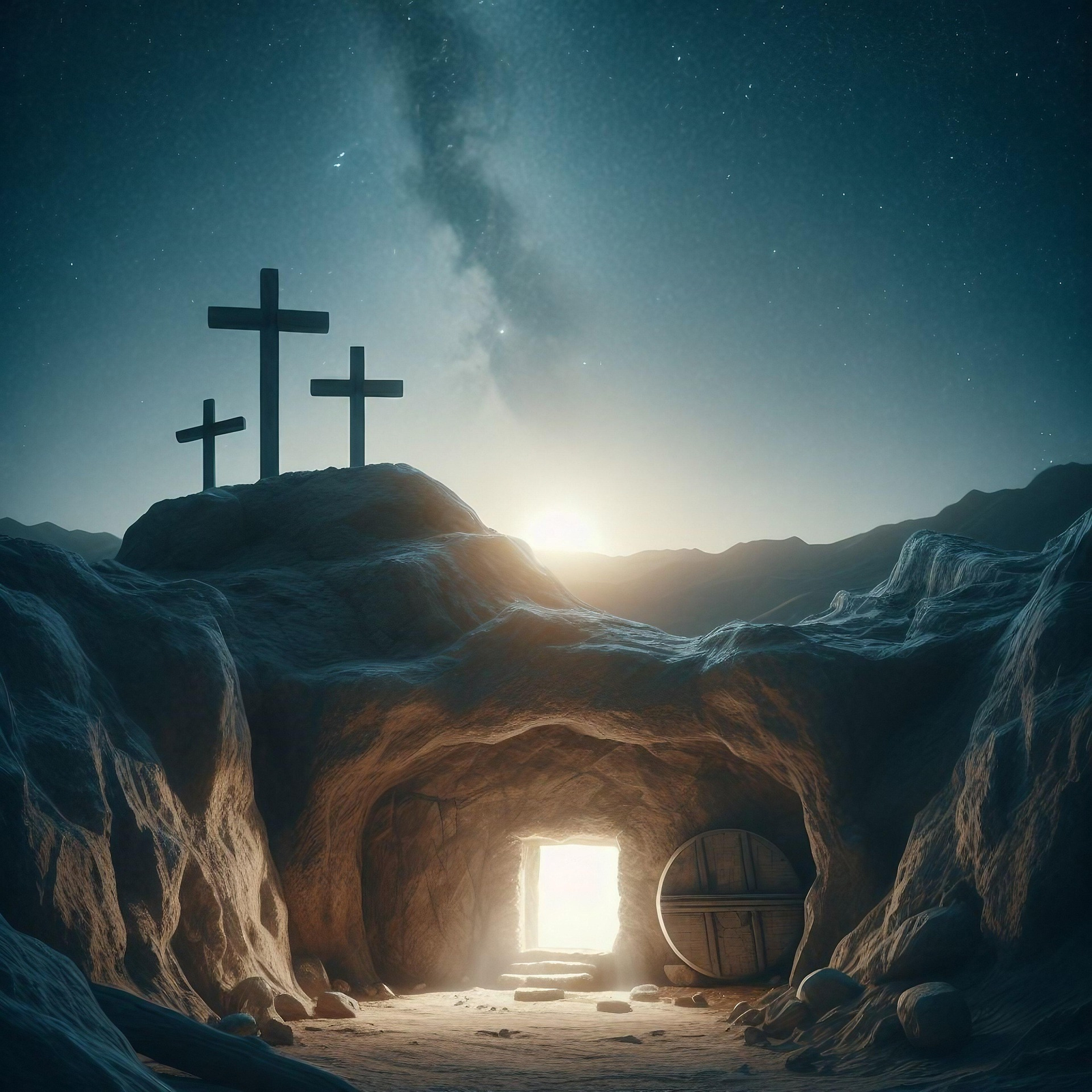
Jesus arose from the tomb on the third day!
After midnight on Friday, everything stood still until the break of sunrise on Saturday (the Sabbath), when suddenly there was a great earthquake and an angel of the Lord descended from Heaven. His countenance was like lightning, and his raiment was white as snow.
The ones keeping watch were frozen in fear of him. Too afraid to move when they saw the angel roll back the stone from the door and sit upon it.
The tomb where Jesus’ body had lain was now empty. As quickly as they could, the watchers ran into the city and reported to the chief priests all the things that had happened. The last thing the Jewish leaders wanted to hear was that the tomb was empty. The chief priests called an urgent assembly with the elders to address the matter. In counsel, they decided to bribe the soldiers to cover up what they had reported. The soldiers took the money and agreed to say the disciples came by night as they slept and stole the body of Jesus. The chief priests also promised them that if word ever got to the governor, they would be protected from punishment.
While the tomb was left unguarded, several groups of women came to the sepulcher, bringing spices they had prepared, and found the stone rolled away. It was on the Sabbath that they came early in the morning, and as early as the rising of the sun.
Mary Magdalene and her group were among the first who came on the Sabbath early in the morning, expecting to find the tomb sealed, but instead found the stone rolled away. While the tomb was still dark, Mary entered and found it empty. Then she runneth, and cometh to Simon Peter, and to the other disciple, whom Jesus loved, and saith unto them, “They have taken away the Lord out of the sepulcher, and we know not where they have laid him.” (John 20:1-2)
Peter and the other disciple both raced to the sepulcher. The other disciple outran Peter and came first to the sepulcher. He looked inside and saw the linen clothes, but waited to go inside. Peter went inside before the other disciple and saw the linen clothes lying and the napkin that was about his head, not lying with the linen clothes but wrapped together in a place by itself. When the other disciple entered, he saw and believed. Then the two disciples went away again to their own home. (John 20:3-8)
Certain other women who came entered the tomb and saw a young man sitting on the right side, clothed in a long white garment, and they were affrighted. He said, “Be not affrighted: Ye seek Jesus of Nazareth, which was crucified: he is risen; he is not here: behold the place where they laid him. But go your way, tell his disciples and Peter that he goeth before you into Galilee; there shall ye see him as he said unto you.” They went out quickly and fled from the sepulcher, but so afraid they never said anything to anyone about what they had witnessed. (Mark 16:2-8)
Another group of women came and entered the tomb and were greeted by two men in shining garments. And as the women were afraid, and bowed their faces to the earth, they said unto them, “Why seek ye the living among the dead? He is not here, but is risen, remember how he spake unto you when he was in Galilee, saying, The Son of man must be delivered into the hands of sinful men, and be crucified, and the third day rise again.” These women returned from the sepulcher and told all these things to the eleven and to all the rest. (Luke 24: 1-9)
Mary was the first to see Jesus alive on the Sabbath
NOTE: Consider these alternate translations of Mark 16:9:
“And he, having risen in the morning of the first of the sabbaths, did appear first to Mary the Magdalene, out of whom he had cast seven demons;” (Mark 16:9) Young’s Literal Translation
“And having risen early the first of the sabbath, he was manifested first to Mary Magdalene, from whom he had cast seven demons.” (Mark 16:9) Smith’s Literal Translation
“But he, rising early on the first Sabbath, appeared first to Mary Magdalene, from whom he had cast out seven demons” (Mark 16:9) Catholic Public Domain Version
On her final visit to the sepulcher, Mary Magdalene had come alone and was weeping. As she wept, she looked inside and saw two angels in white sitting, the one at the head, and the other at the feet, where the body of Jesus had lain. And they say unto her, “Woman, why weepest thou? She saith unto them, Because they have taken away my Lord, and I know not where they have laid him. And when she had thus said, she turned herself back, and saw Jesus standing, and knew not that it was Jesus. Jesus saith unto her, Woman, why weepest thou?” Whom seekest thou? She, supposing him to be the gardener, saith unto him, Sir, if thou hast borne him hence, tell me where thou hast laid him, and I will take him away. Jesus saith unto her, Mary. She turned herself, and saith unto him, Rabboni; which is to say, Master. Jesus saith unto her, Touch me not, for I am not yet ascended to my Father: but go to my brethren, and say unto them, I ascend unto my Father, and your Father; and to my God, and your God. (John 11:18
Then afterward, other women came and found the tomb empty. And the angel answered and said unto the women, Fear not ye: for I know that ye seek Jesus, which was crucified. He is not here: for he is risen, as he said. Come, see the place where the Lord lay. And go quickly, and tell his disciples that he is risen from the dead; and behold, he goeth before you into Galilee; there shall ye see him: lo, I have told you. And so they departed quickly from the sepulcher with fear and great joy and did run to bring His disciple word. And as they went to tell his disciples, behold, Jesus met them, saying All hail. And they came and held him by the feet, and worshipped him. Then said Jesus unto them, Be not afraid: go tell my brethren that they go into Galilee, and there shall they see me.
The Disciples See Jesus Risen From the Tomb
Up until dusk, while it was still the Sabbath, none of the disciples had yet seen the Lord alive or the angels who had sent the women to tell them that Jesus was risen. Therefore, the disciples had yet to believe. It was Mary Magdalene, and Joanna, and Mary the mother of James, and other women who were with them, who told these things unto the apostles. And their words seemed to them as idle tales, and they believed them not. (Luke 24:10-11)
And behold, two of them went that same day to a village called Emmaus, which was from Jerusalem about threescore furlongs. And they talked together of all these things which had happened. And it came to pass that, while they communed together and reasoned, Jesus himself drew near, and went with them. But their eyes were held so that they should not know him.
(Luke 24:13-16)
As Jesus went further with them, one named Cleopas summarized the events that had occurred and admitted that “certain women also of our company made us astonished, which were early at the sepulcher; and when they found not his body, they came, saying, that they had also seen a vision of angels, which said that he was alive.” Eventually, Jesus told them they were fools and slow to believe. Then he expounded unto them in all scriptures the things concerning himself, beginning at Moses and all the prophets. After he had taken bread and eaten with them, their eyes were opened, and they knew him, and he vanished out of their sight. (Luke 24: 23-32)
The same hour, they returned to Jerusalem and found the eleven gathered together, and them that were with them, and shared that they were with the Lord.
Evening of Sabbath
Then the same day in the evening, being the weekly Sabbath, when the doors were shut where the disciples were assembled for fear of the Jews, Jesus came and stood in the midst and said unto them, Peace be unto you.
And when he had so said, He shewed unto them His hands and His side. Then the disciples were glad when they saw the Lord. (John 20:20-21)
Nisan 20
Then came Sunday, following the day Jesus arose from the tomb; however, it was still a feast day. The evening would begin the next annual Sabbath.
Nisan 21
Final day of the Feast of Unleavened Bread and Passover week. The annual Sabbath would end in the evening.
Leave a Reply